


For most of the last decade, mobile gaming ran on one bet: build something dead-simple, blast it across ad networks, and ride the install wave before players got bored. It worked, until it didn’t. Boredom showed up faster every year, install costs crept up, and the whole thing started to feel like pouring water into a leaky bucket.
Hybrid-casual is the patch on that bucket. And in 2026, it’s no longer a clever experiment on the margins it’s where the money is actually moving. Most players have no idea it happened, because the games still look as harmless as ever.
The numbers say it plainly. Hybrid-casual was the standout revenue gainer of 2025, climbing sharply while plain casual and mid-core stayed flat. Downloads slipped almost everywhere, yet hybrid-casual held its day-7 retention above traditional casual games even as casual kept sliding year after year. In a market that’s basically gone zero-sum, that gap is the difference between growing and treading water.
What is “Hybrid Casual”
Strip away the buzzword and the idea is simple: take a game anyone can understand in ten seconds, then give them a reason to still be playing two months later.
The first half is the core loop. One or two controls, usually a tap or a swipe, no tutorial needed. You see it, you get it, you’re playing. This is the part borrowed straight from hyper-casual, and it’s what keeps acquisition cheap a playable ad can show the whole loop in five seconds.
The second half is the meta layer, and this is where the genre earns its keep. Think:
- Upgrades and gear collection – fusing weapons, leveling stats, chasing rare drops.
- Character progression – talents, runes, unlockables that compound over time.
- Social and live systems – guilds, clans, leaderboards, seasonal events.
None of it is complicated on its own. But stacked together, it turns a throwaway time-killer into something with goals and momentum. The cleanest way to put it: hyper-casual optimizes for “play now,” hybrid-casual optimizes for “play now and come back tomorrow.”
The textbook example is Archero. Habby’s 2019 release is still the genre’s golden standard. The core is almost embarrassingly simple stand still and you auto-attack, move and you dodge. But underneath sits a full RPG economy of gear collection, fusion, talents, runes, and gacha chests. Survivor.io ran the same play and pushed it further, bolting on a season pass, idle income, clans, daily boss fights, and a “Growth Fund” that drip-feeds rewards across a player’s entire lifespan for one purchase. Same DNA, deeper hooks.
Spend ten minutes with either game and the trick gives itself away. The first session feels like a toy. By the fifth, you’re weighing which weapon to fuse and whether the battle pass is worth it. That slow handoff from reflex to investment is the whole philosophy in miniature.
The Monetization Shift That Changed Everything
This is the part that genuinely rewrote studio strategy.
The old playbook was binary. Hyper-casual games lived on in-app ads (IAA). Mid-core and hardcore games lived on in-app purchases (IAP). You picked a lane. Hybrid-casual refused to pick, and that refusal turned out to be the entire point.
The modern approach blends the two so they prop each other up:
- Rewarded video ads stay optional. Players choose to watch them for extra currency, a revive, or to skip a wait so the ad feels like a perk, not an interruption. This format now drives the majority of ad revenue in these games.
- In-app purchases carry the depth: premium currency, cosmetics, battle passes, and long-tail upgrades dedicated players are happy to buy while the base game stays free.
Why bother with the complexity? Because the math is lopsided. Hybrid lifetime value runs roughly three to five times higher than pure hyper-casual, mostly because IAP creates an upside ceiling that ads alone can’t reach. A 2026 wrinkle worth watching is “interventionist” monetization small revival packs and currency bundles priced around two to eight dollars that pop up right at a frustrating failure point, nudging an impulse buy when the player most wants to keep going.
Archero’s own transition is the cleanest proof. When Habby moved it from a thin ad-based model to a layered hybrid economy, the risk was churn an early hybrid pivot can overwhelm a casual base and bleed users fast. Done carefully, the payoff was a roughly 90% lift in average lifetime value and a meaningful retention boost, on top of a game that had already crossed tens of millions of downloads. That single result is why so many studios now treat the hybrid pivot as a question of when, not if.
Why Studios are Walking Away From Pure Hyper Casual
The honest answer is that the old model stopped paying the bills reliably.
The hyper-casual gold rush flooded the stores. Anyone learning to code could ship a tap-to-play game, publishers handed out easy deals, and the result was an ocean of near-identical titles fighting for the same attention. That saturation pushed cost-per-install up and dragged retention, playtime, and LTV down. When your only revenue lever is ad impressions and players churn in days, there's no room left to maneuver.
Hybrid-casual hands studios a second lever. By keeping the cheap, broad-appeal acquisition of hyper-casual while layering in systems that keep players spending for weeks or months, it builds a more defensible economy. For investors, that’s the appeal: scalable retention plus diversified monetization makes long-term revenue far more predictable than betting on a single ad-impression number.
There’s a marketing angle too. Rising acquisition costs and tighter data-privacy rules have made old hyper-casual marketing shakier. Hybrid titles get around it by letting one playable ad do double duty showing the simple core loop to pull in mainstream players, while flashing the RPG progression to hook veterans who’d never touch a pure tapper.
The Catch This is Much Harder to Build

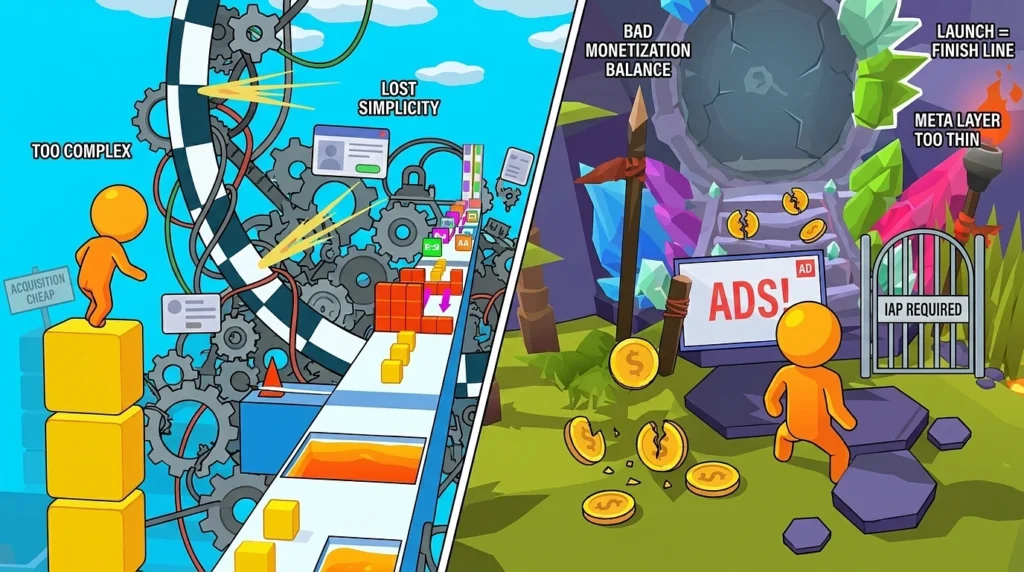
None of this comes free, and the studios that fail tend to fail the same ways:
- Over-complicating the core, until it loses the simplicity that made acquisition cheap.
- A meta layer too thin to motivate anyone past week one.
- Bad monetization balance leaning too hard on ads or on IAP instead of blending them.
- Treating launch as the finish line.
That last one matters most in 2026. A hybrid game’s development cycle typically runs nine to twelve months, and the expectation is sustained operation, not a quick flip. LiveOps, seasonal events, and social features aren’t optional polish anymore they’re what keeps the economy breathing after launch-week installs dry up.
This is also where AI stopped being a buzzword. Past the hype phase now, studios use it across the pipeline: prototyping and blending genres during ideation, simulating game economies before a line of production code is written, and personalizing difficulty and offers to individual players once a game is live.
Where This Leaves the Industry
The clearest sign hybrid-casual won the argument is that everyone else is copying it. Mid-core and hardcore publishers are now grafting hybrid mechanics onto their own genres RPG plus simulation, tower defense plus idle, match-3 plus narrative to feel fresh in saturated categories without reinventing their core. Titles like Royal Match and Survivor.io have already blurred the casual-versus-mid-core line until the old labels barely hold.
For studios deciding where to spend their next nine months, the takeaway is blunt. The era of bolting monetization and retention on after launch is over. In a flat market where downloads are shrinking and attention is the scarce resource, durability beats acquisition. Hybrid-casual is winning because it bakes that durability into the design from the very first prototype and right now, nothing else in mobile is doing it as efficiently.